
Published figures run from a few thousand dollars to several hundred thousand, and both ends can be accurate. The gap comes from what people mean by a telemedicine website: a clinic site with online booking, a site with intake and payments, or a full virtual care platform with video visits.
This is a cost-factors guide, not a price list. It separates the three scopes, explains what moves the price within each, covers the costs that continue after launch and gives you a checklist for collecting quotes you can compare side by side.
Website, portal or full platform? Know what you're pricing
Before you compare any numbers, decide which of these three scopes you are buying. Each has different cost drivers, and quotes for different scopes cannot be compared.
| Scope | What it includes | Main cost drivers |
|---|---|---|
| Marketing website with booking | Service pages, provider profiles, content, online booking or a scheduling widget, contact forms | Design approach, number of pages, content, SEO and accessibility work |
| Website with intake, payments and patient accounts | Everything above, plus patient intake forms, payments, patient logins and secure messages | Secure form handling, payment setup, patient portal features, scheduling or EHR integrations |
| Full telehealth platform | Video visits, async care, provider dashboards, e-prescribing and clinical workflows | Video infrastructure, EHR integration, clinical workflow logic, security and compliance scope |
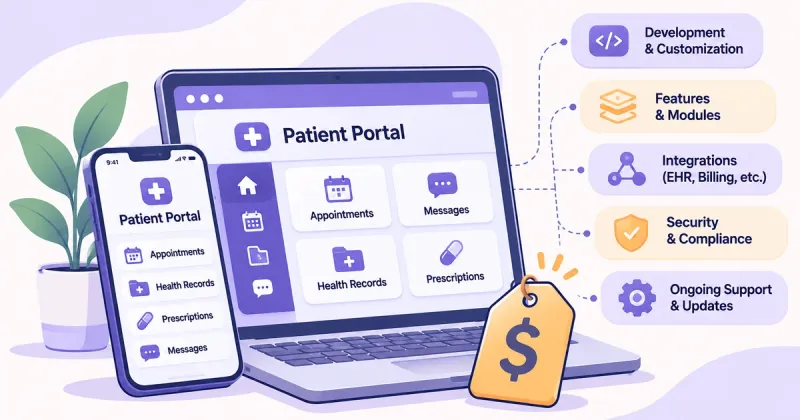
The middle scope overlaps with patient portal development, where patients log in to see appointments, forms and messages. The third is a software product rather than a website. If that is what you need, see our custom telehealth software solutions.

A simple test helps you choose. If patients only need to find you and book, the first scope fits. If you want to collect forms, payments or messages before a visit, you need the second. If care itself happens online, through video or async consults, you are pricing a platform.
You can also start with the first or second scope and add platform features later. Planning the site for that from the start avoids a rebuild.
What drives telemedicine website cost
Within any scope, five factors decide where your telemedicine website development cost lands.

Design: template vs custom UI/UX
The custom design vs template choice is usually the first big fork in a quote. A template gives you a proven layout at a lower cost, with limited room to change how booking and intake work. Custom UI/UX design starts with discovery: mapping how patients find a service, book and complete forms, then designing pages around those steps. Discovery usually produces a sitemap, user flows and wireframes, which also make later quotes more accurate.
Custom work costs more upfront but fits your care model. Either way, the site must be mobile-friendly. Patients will open booking links and forms on their phones, so test every flow on a small screen.
Features: booking, intake, payments and patient accounts
Each feature adds design, build and testing work:
- Online booking and appointment scheduling, from a third-party widget to a custom scheduler tied to provider calendars
- Patient intake forms, from a simple contact form to multi-step forms with consent and insurance details, or AI patient intake that adapts questions to each patient
- Payments through a processor such as Stripe, for self-pay visits, deposits or subscriptions
- Insurance details captured at booking, if you bill payers
- Patient accounts and a patient portal for visit history, forms and messages
- Video visits, if you build them into the site instead of linking to a separate tool
The lowest-cost version of each feature is an embedded third-party tool. The highest-cost version is a custom build that matches your workflow exactly.
Integrations: EHR, scheduling and payments
Integrations are often the hardest line in a quote to predict. Connecting booking and intake to your EHR may use HL7 standards such as FHIR or the vendor's own APIs, and the effort depends on what your EHR exposes. Payment processors and scheduling tools tend to be simpler, with documented APIs.
Ask each vendor to list every integration separately, with its own estimate.
Security and optional HIPAA alignment
A site that only shows information and takes general inquiries holds little patient data. Once it collects health details through intake forms, messages or patient accounts, it handles protected health information (PHI), and the security work grows.
- Encrypted forms and storage, with SSL across the whole site
- Role-based access and audit logs for staff
- Hosting from a provider that signs a business associate agreement (BAA)
- Security testing before launch and after major changes
The HIPAA Security Rule sets out the safeguards for electronic PHI. HIPAA alignment changes hosting, form tools and testing, so decide on it at the start. Our HIPAA-compliant web development work covers this scope. If your site will handle PHI, we build it to be HIPAA-aligned from the start; if it only shares information, that work is optional.
Content, SEO, accessibility and page speed
Copywriting, medical review of content, provider bios and photos all take time. So does SEO: page structure, metadata, local search setup and page speed. A CMS that your team can update without a developer adds setup work but saves support costs later.
Accessibility matters for patients with disabilities, and building to WCAG guidelines with the ADA in mind costs less during the build than as a retrofit. Project Cost Estimator's 2026 guide puts ADA and WCAG compliance work at $1,500–$8,000 added to a healthcare website build.
Published cost ranges (and why they differ)
The figures below come from Project Cost Estimator's 2026 healthcare website cost guide, an independent cost estimator. They are industry ranges, not NewByte prices, and each covers a different scope. That is why telemedicine website cost estimates look so far apart.
| Source (year) | What it prices | Published range |
|---|---|---|
| Project Cost Estimator (2026) | Solo provider website (freelancer / agency) | $2,500–$6,500 / $5,500–$14,000 |
| Project Cost Estimator (2026) | Small group practice, 2-5 providers (freelancer / agency) | $5,000–$14,000 / $12,000–$32,000 |
| Project Cost Estimator (2026) | Multi-location group (freelancer / agency) | $12,000–$32,000 / $28,000–$75,000 |
| Project Cost Estimator (2026) | Specialty clinic with patient portal and telehealth (freelancer / agency) | $25,000–$65,000 / $55,000–$140,000 |
| Project Cost Estimator (2026) | Telehealth video added to a site | Up to $15,000 added |
| Project Cost Estimator (2026) | Patient portal added to a site | $3,500–$45,000 added |
| Project Cost Estimator (2026) | HIPAA compliance work | $800–$5,000 added, plus $60–$400 a month for BAA-ready hosting |
Telehealth website development cost varies this much for four main reasons:
- Scope. A booking site and a video platform are different products, yet both get called telemedicine websites.
- Team rates. Project Cost Estimator's 2026 guide gives separate freelancer and agency figures for each practice size, and the agency figure is often about twice the freelancer one.
- Integrations and compliance. EHR connections and PHI handling add work that a brochure site does not need.
- What is included. Some figures include content, SEO and support; others cover only the build.
Use these ranges to sense-check a quote, not to set a budget. Your own scope document is the only reliable basis for a number.
Ongoing costs after launch
The build is only part of the total cost of ownership. Plan for these recurring costs:
- Hosting and SSL, with HIPAA-aligned hosting if the site handles PHI
- Maintenance and updates to the CMS, plugins and frameworks
- Security patches, backups and monitoring
- Support for bug fixes and small changes
- Content updates and ongoing SEO
- Integration upkeep when an EHR, scheduling or payment vendor changes its API
- Subscriptions for third-party booking, form, video or e-signature tools
For scale, Project Cost Estimator's 2026 guide lists monthly running costs from $80–$220 for a solo provider site to $650–$1,800 for a specialty clinic, with BAA-ready hosting adding $60–$400 a month. Telemedicine website maintenance cost rises with every integration and custom feature, so ask each vendor to price support separately from the build.
Decide early who will do this work. Some practices keep a developer on a monthly support plan; others handle content in-house and call a vendor only for technical changes. Either way, write down who applies security updates and how quickly, because an unpatched site that collects patient data is a risk, not a saving.
How to get a telemedicine website quote you can compare
Two quotes are only comparable if they price the same scope. The only real answer to what it costs to build a telehealth website is a quote based on a written brief, so send every vendor the same one, covering:
- A scope document: pages, user types (patients, providers, staff) and the main flows
- A feature list, marked must-have or later
- Every integration: EHR, scheduling, payments, video and CRM
- Compliance needs, including whether you want HIPAA alignment
- Who owns the code, the content and the patient data at the end of the project
- What support includes after launch, and how it is priced
- How changes to scope are handled and approved

Then ask how each vendor structures its telemedicine website pricing. A fixed price suits a well-defined scope. Time and materials suits work that will change as you learn. A phased build, starting with a focused first release or MVP, lets you launch the core patient journey and add features once you see how patients use it.
When you are ready to speak to a telemedicine website development company, use this list as your brief. Our engineers scope every build against it, and we give you a timeline once we've scoped your build.
Watch for these warning signs when quotes come back:
- A single total with no breakdown by design, build, integrations and testing
- No mention of hosting, security updates or support after launch
- Integrations listed as "included" without naming the systems
- No answer on who owns the code and data
- A very low price for a scope that includes patient accounts or video, which can mean features will be added later as change requests
Ways to control the cost without cutting corners
- Build in phases. Launch booking and intake first, then add patient accounts or video once you have usage data.
- Reuse proven components. Established scheduling, payment and form tools cost less than custom versions and are already tested. For a full platform, a white label telehealth platform applies the same idea.
- Skip features patients won't use. Every feature costs money to build and maintain. If it does not support a step in the patient journey, leave it for a later phase.
- Decide on compliance early. Changing hosting or form tools after launch costs more than choosing them at the start.
- Measure before adding more. Track bookings, form completion and drop-off, and let the data decide the next phase.
Get a scoped estimate for your telemedicine website
Telemedicine website cost comes down to scope: which of the three levels you need, the features and integrations inside it, how you handle patient data and what support looks like after launch. Put those on paper first, and the quotes you receive will be comparable.
Want a scoped estimate for your telemedicine website? Our engineers can review your scope with you and explain which cost drivers apply to it. Book a call