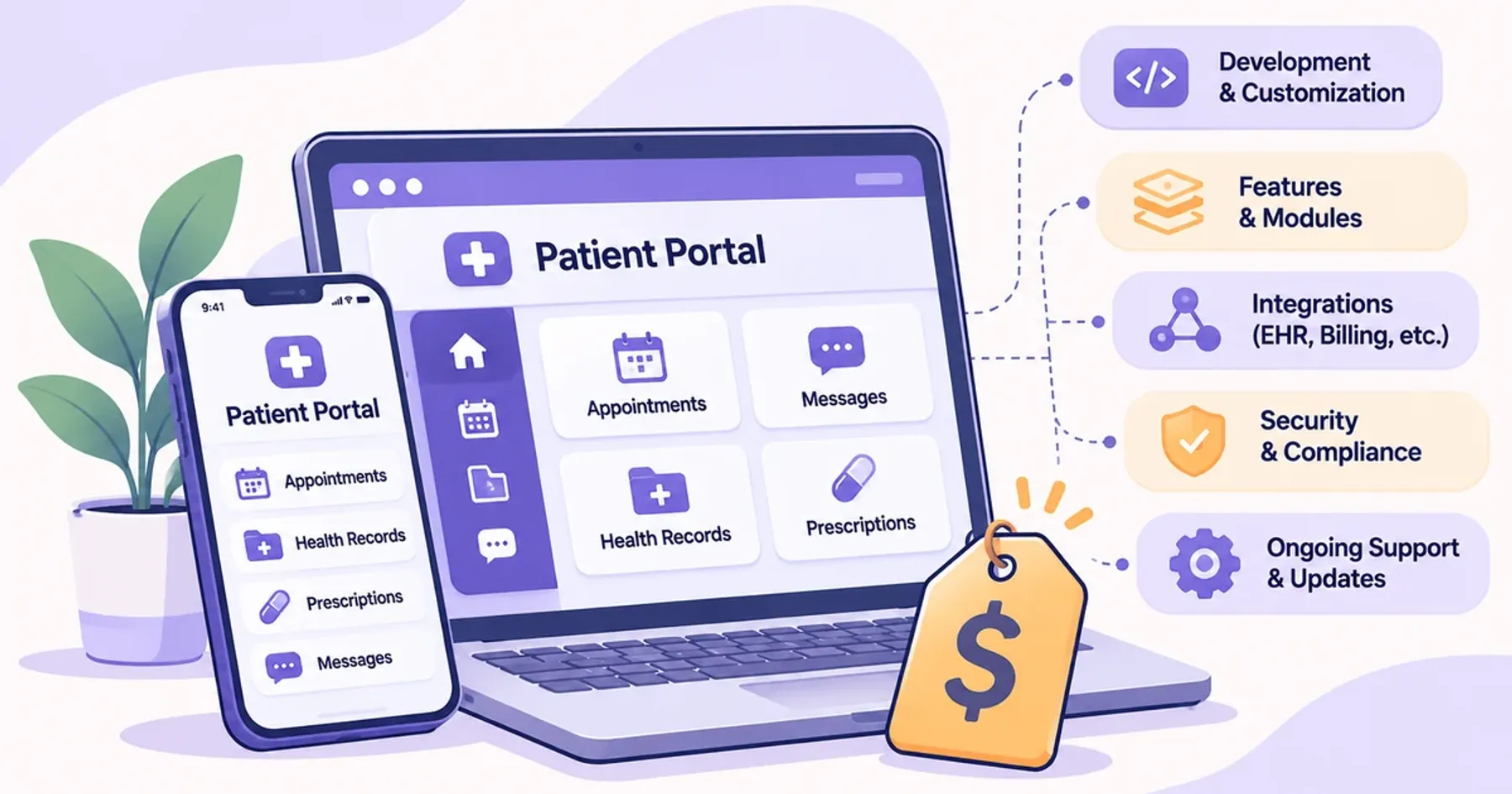
The cost of a patient portal depends first on which route you take: switching on your EHR's own portal, licensing an off-the-shelf or white-label portal, or building a custom portal. Each route has a different cost structure, and published figures mix them together.
This is a cost-factors guide, not a price list. It compares the three routes, explains what drives the cost within each, covers the costs after launch and shows how to scope a first release so the budget goes to features patients actually use.
Three ways to get a patient portal
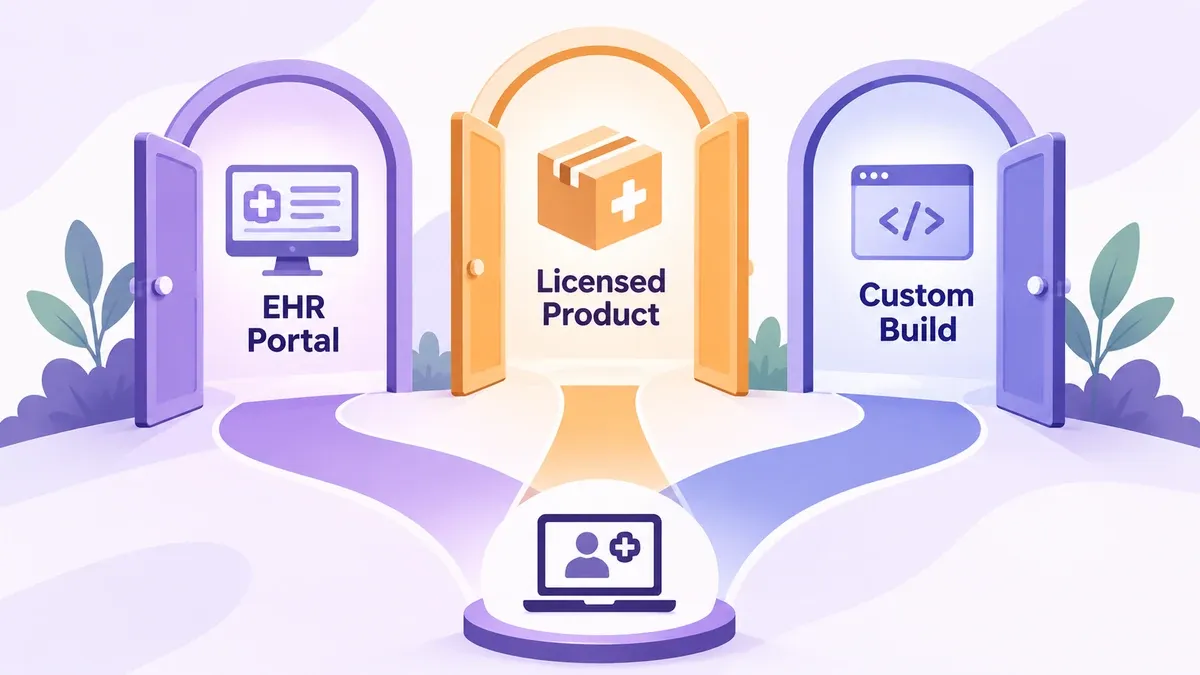
Clinics and health startups have three realistic options for a patient portal:
| Route | What you get | Main costs | Best for |
|---|---|---|---|
| EHR-native portal | The portal that comes with your EHR, such as MyChart-style portals, already connected to your records | License or module fees, setup, configuration and staff training | Practices whose needs fit the EHR's standard patient features |
| Off-the-shelf or white-label portal | A ready-made portal product, often under your brand, connected to your systems | Setup fees, monthly license fees, integration work | Teams that want a branded portal without a full build |
| Custom portal | A portal designed around your patients, workflows and systems | Discovery, design, development, EHR integration, testing, hosting and support | Telehealth providers, multi-system groups and services with workflows standard portals do not support |
An EHR-native portal is often the cheapest place to start, but you get the patient experience your EHR vendor designed. A custom portal costs more upfront and gives you control over every screen and workflow. The off-the-shelf or white-label portal sits in between.
A quick way to choose:
- If your EHR's portal covers the tasks your patients need, start there and spend on adoption instead of development.
- If you need your own brand and a few extra workflows, compare white-label portals that integrate with your EHR.
- If the portal is part of your product, such as a telehealth service or care program, or must connect several systems, plan a custom build.
What drives patient portal cost
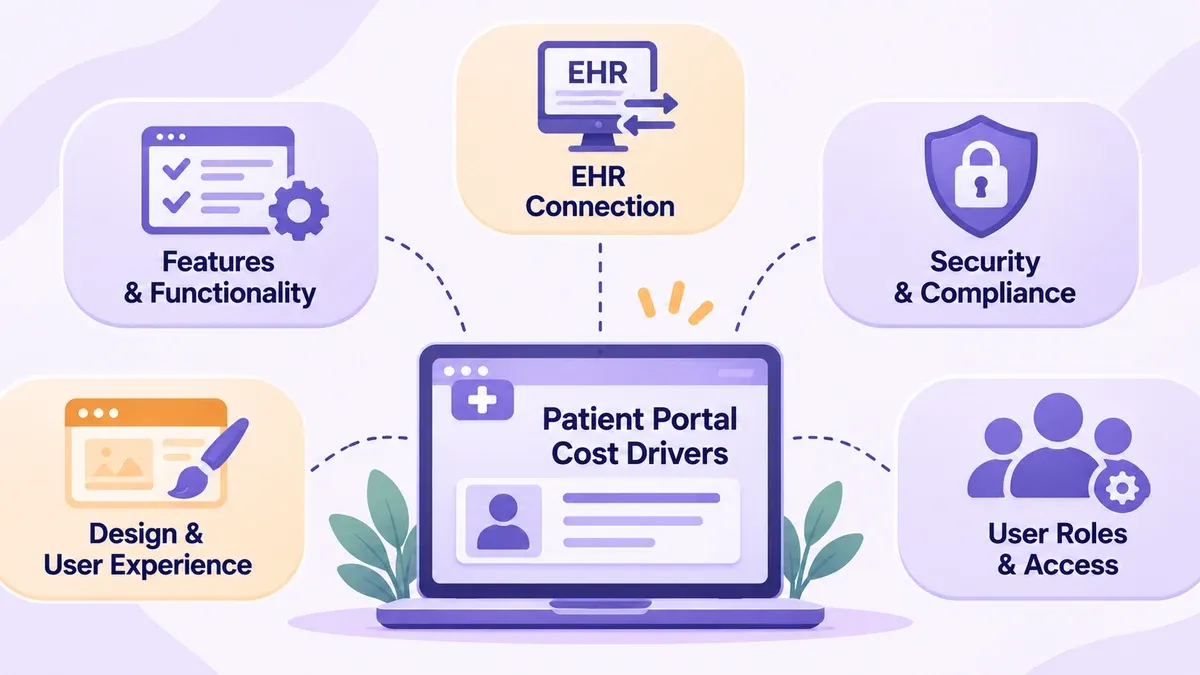
Within any route, five drivers decide your patient portal development cost.
Features in the first release
Every feature adds design, development, testing and support work. Common patient portal features include:
- Appointment scheduling and reminders
- Secure messaging with the care team
- Test results and visit summaries
- Forms and consents completed before the visit, including AI patient intake that adapts questions to each patient
- Bill pay and statements
- Prescription refills
- Proxy access for parents and caregivers
- Telehealth visits from inside the portal
A web portal costs less than a web portal plus a native mobile app. Decide early whether patients need an app or whether a mobile-friendly web portal is enough for the first release.
Features also depend on other systems. Test results need data from your EHR or lab, bill pay needs your billing or payment system, and scheduling needs live provider calendars. A feature that looks simple on a list can carry an integration behind it.
EHR integration and interoperability
EHR integration is often the largest line item in a custom portal quote. Connecting to your EHR may use HL7 standards such as FHIR or the vendor's own APIs, and the effort depends on which data you read, whether you write data back and how many systems you connect.
Ask vendors to price each interface separately, because reading data from one EHR and writing data back to several systems are very different jobs. Interoperability rules also matter: under federal information blocking rules, patient access to electronic health information should not be blocked without a valid reason, so plan how data reaches patients.
Security and optional HIPAA alignment
A patient portal shows protected health information, so security work is part of the core build:
- Identity verification when patients first register
- Two-factor authentication at login
- Role-based access and audit logs for every record viewed or changed
- HIPAA-aligned hosting from a provider that signs a business associate agreement (BAA)
- Security testing before launch and after major changes
Planning these controls from the start costs less than adding them after launch, because hosting, login and audit choices shape the whole build. Our HIPAA-compliant web development work covers this scope, and for HIPAA-covered practices we build the portal to be HIPAA-aligned from the start.
Design, accessibility and mobile
Portal users include older patients, caregivers and people using screen readers. Building to WCAG accessibility guidelines, testing with real patients, offering multilingual content where your patients need it and designing for small screens all add work, and all affect whether patients use the portal at all. Check contrast, font sizes and keyboard navigation in the design stage, because fixing them after launch means rework.
Number of user roles
A portal for patients only is the simplest case. Each extra role, such as providers, front-desk staff and administrators, adds screens, permissions and testing. If clinicians need their own workspace to review messages, forms and visits, scope it with provider dashboard development rather than adding it as an afterthought.
Published patient portal cost ranges
The figures below come from Project Cost Estimator's 2026 healthcare website cost guide, an independent cost estimator. They are industry ranges, not NewByte prices, and each covers a different scope.
| Source (year) | What it prices | Published range |
|---|---|---|
| Project Cost Estimator (2026) | Patient portal added to a healthcare website | $3,500–$45,000 |
| Project Cost Estimator (2026) | Licensed portal product | $3,500–$15,000 setup, plus $200–$900 a month |
| Project Cost Estimator (2026) | Custom HIPAA patient portal | $25,000–$70,000 to build, plus $300–$1,400 a month |
| Project Cost Estimator (2026) | Specialty clinic website with patient portal and telehealth (freelancer / agency) | $25,000–$65,000 / $55,000–$140,000 |
| Project Cost Estimator (2026) | HIPAA compliance work on a healthcare website | $800–$5,000, plus $60–$400 a month for BAA-ready hosting |
The ranges differ because of what each one includes: one or several EHR integrations, a web portal alone or a mobile app too, and whether compliance, testing and project management are counted. Patient portal pricing for licensed products also depends on the number of patients, providers or locations.
Upfront price is not the whole picture. A licensed portal's monthly fees and a custom portal's hosting and support add up over the years, so compare routes on total cost of ownership over the same five-year period, not on the first invoice.
Treat these as a reference point for checking quotes. The real answer to how much it costs to build a patient portal for your clinic comes from your own scope, not from an average.
Ongoing costs after launch
Patient portal maintenance cost continues for as long as the portal runs. Project Cost Estimator's 2026 guide lists $300–$1,400 a month in running costs for a custom HIPAA portal and $200–$900 a month for licensed portal products. Maintenance usually covers:
- Hosting, backups and monitoring
- Security updates and periodic security testing
- EHR interface upkeep when your EHR vendor changes its APIs
- Bug fixes and small improvements
- Patient and staff support
- Adoption work: training staff, promoting the portal and helping patients sign up
Adoption is a real cost line. An ONC data brief found that in 2022, 73% of individuals were offered online access to their medical records, but only 57% were offered access and used it at least once. Budget for helping patients start using the portal, not just for building it.
Each EHR interface also needs its own upkeep, so the number of integrations is one of the biggest drivers of long-term cost.
How to scope release one and control cost
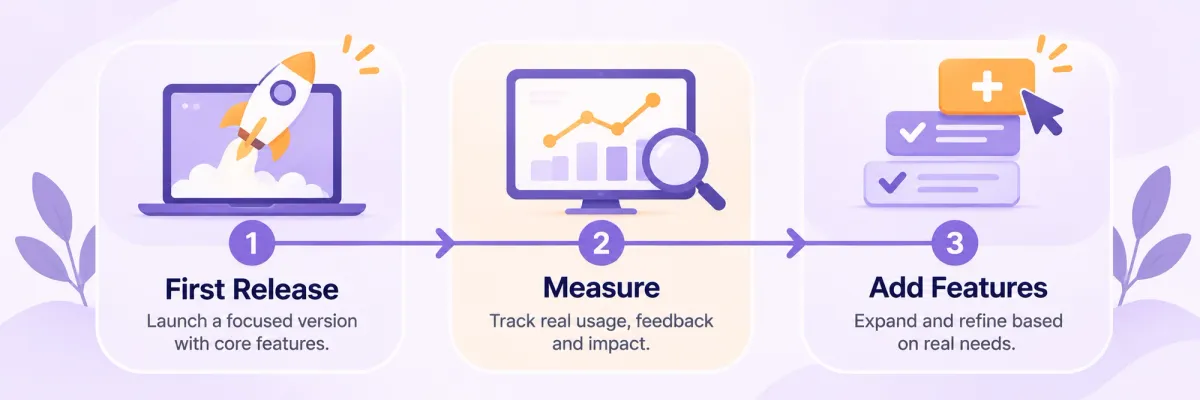
The most expensive portal is one that patients do not use. Scope release one around the tasks patients need most, then add the rest in phases.
- List patient tasks. Ask front-desk staff which requests take the most calls: booking, results, forms, payments or refills.
- Pick the first release. Choose the three to five features that remove the most calls and admin work. Treat this as your MVP.
- Limit integrations. Connect the data release one needs, and plan the rest for later phases.
- Measure adoption. Track sign-ups, logins and completed tasks, and compare call volumes before and after launch.
- Plan phased releases. Add proxy access, telehealth visits or a mobile app when the data shows patients will use them.
Release one also needs the admin basics: account management, access resets for locked-out patients and simple usage reports. Without them, staff time goes into workarounds instead of patients.
This keeps custom patient portal cost tied to results you can measure. Our patient portal development work follows the same approach: scope release one, launch, measure, then grow.
Questions to ask before you get a quote
Send every vendor the same questions so the answers are comparable:
- Which EHR and other systems will the portal connect to, and is each integration priced separately?
- Who owns the portal code and the patient data, and how would we export it?
- Who hosts the portal, and will the host sign a BAA?
- What do support and maintenance include, and how are they priced?
- How will you meet WCAG accessibility guidelines, and how will you test it?
- Exactly which features are in release one, and which are planned for later?
- For licensed products, how does patient portal software cost change as we add patients, providers or locations?
Also ask how the vendor prices the work. A fixed price suits a well-defined release one. Time and materials suits later phases that will change as you learn from patients. Either way, the scope document should list every feature and integration by name.
Vague answers on integrations, ownership or support are where costs grow later.
Scope your patient portal's first release
Patient portal cost comes down to the route you choose, the features in release one, the integrations behind them and the upkeep after launch. If your portal is part of a wider virtual care build, see our custom telehealth software solutions for the full range of services.
Want a realistic scope for your patient portal? Our engineers can help you define release one and the cost drivers that apply to it. Book a call